

Rights of Nature in Europe
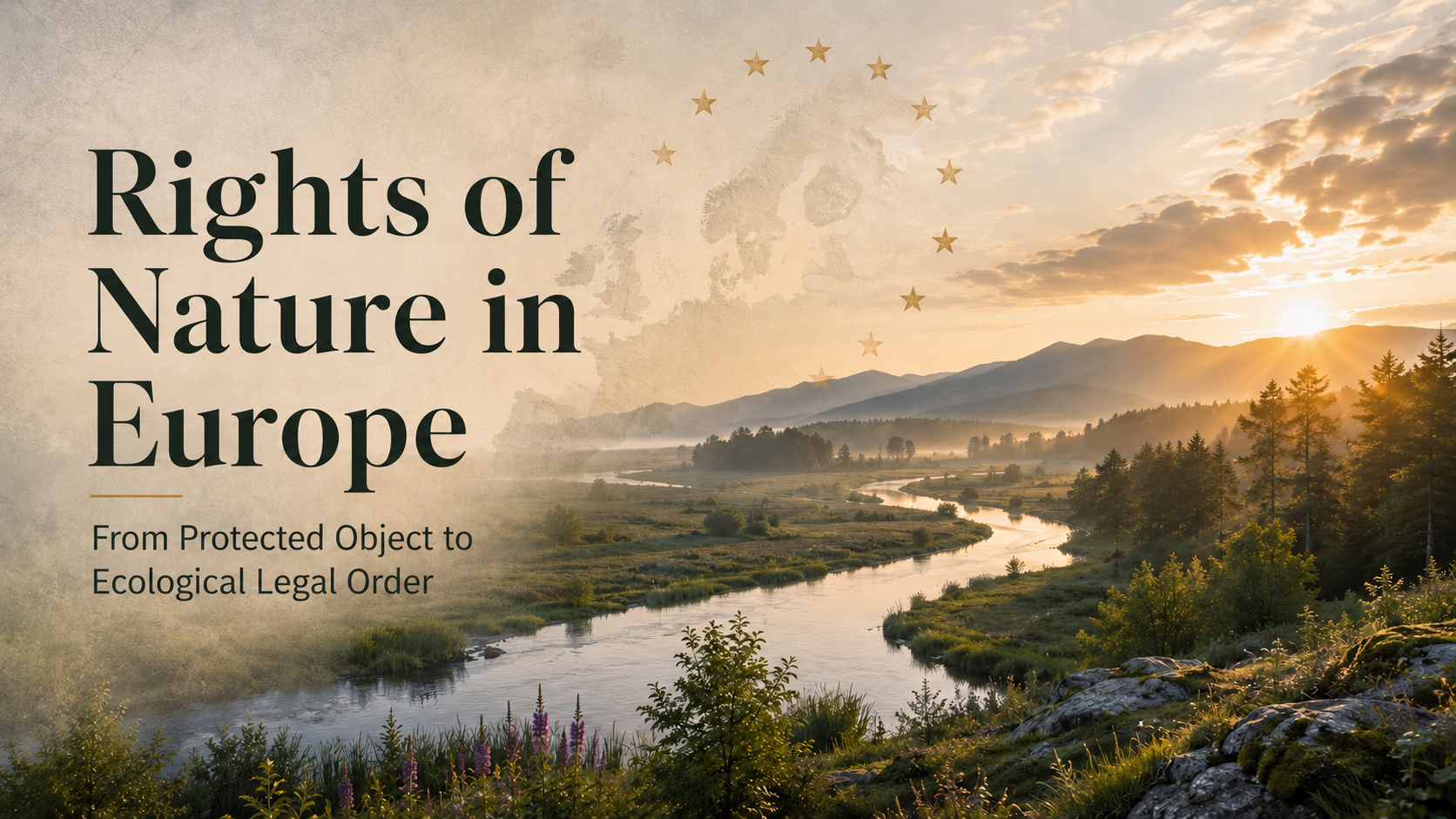
Rights of Nature in Europe
From Protected Object to Ecological Legal Order. A German perspective on the European Citizens’ Initiative “Rights for Nature”.
Core thesis
They mark a shift in legal standards: ecosystems must not only be protected once their destruction is already underway. Their ecological integrity must become an independent standard of assessment and justification, to be considered from the outset by lawmakers, public authorities and courts.
A new European moment
On 19 May 2026, the European Commission registered the European Citizens’ Initiative “Rights for Nature: Empower Citizens to Represent and Protect Ecosystems”. This opens a formal European space for the question of whether ecosystems should be recognised in EU law as bearers of their own rights.
The initiative calls for a European legal act, such as a directive or regulation, to recognise Rights of Nature in European law and strengthen the protection of ecosystems. Its annex goes beyond symbolic recognition. It refers to an integrated legal and governance framework, legal personality, representation models, access to legal mechanisms and a possible first operationalisation within the Natura 2000 network.
The initiative also explicitly builds on the EESC study “Towards an EU Charter of the Fundamental Rights of Nature”, published by the European Economic and Social Committee in 2020. It therefore stands within a longer legal and political development that now needs to be translated into concrete European and national implementation.
The German question
From a German perspective, the decisive issue is how Rights of Nature can be translated into the existing constitutional, administrative and legal culture. The debate must not be reduced to legal personality and court representation. Both may be important. But they are not the whole point.
The deeper legal meaning lies in the recognition of ecological integrity as an independent standard of assessment and justification. Rights of Nature should not become visible only once an ecosystem is already damaged and litigation begins. They must shape legislation, planning, administrative decision-making, monitoring, restoration and judicial reasoning from the outset.
Article 20a of the German Basic Law as a point of departure
Germany already has a constitutional point of departure: Article 20a of the Basic Law. It obliges the state to protect the natural foundations of life and animals, also in responsibility for future generations, through legislation, executive power and the judiciary.
Article 20a does not itself create subjective rights of nature. It is not a direct right of ecosystems to sue. But it does contain a constitutional opening for a stronger ecological standard of review. Rights of Nature can build on this opening without overstretching Article 20a: as a concretisation of a protective mandate that has too often remained abstract.
The implementation gap
European and national environmental law already contains many protective instruments: the Habitats Directive, the Water Framework Directive, environmental impact assessment, species protection law, climate protection law and the Nature Restoration Regulation. Yet practice repeatedly reveals a structural problem: environmental law may formally exist and still operate too late, too weakly or too fragmentedly.
A river may be assessed through separate categories: water quality, flood protection, individual species, compensation areas, technical interventions and economic interests. Each question receives its own expertise, its own competence and its own balancing exercise. In the end, a project may be authorised even though the river as a living ecological whole is further weakened.
The law sees parts, but not always the whole. It assesses interventions, but not always ecological integrity. It compensates damage, but does not reliably prevent it.
From knowledge to legal record
The point is not merely to recognise these protection gaps. They must become part of the legal record. As long as ecological integrity remains only a scientific finding, political impression or civil-society critique, it can easily be displaced.
Once it is documented in submissions, administrative responses, gaps in reasoning, conditions, monitoring references or comparable cases, it becomes legally connectable. This is a central contribution of Systemic Legal Development: not to claim entirely new knowledge, but to translate known protection gaps into legally usable material.
Systemic Legal Development
Systemic Legal Development is not a competing model to Rights of Nature. It is a method for making the European impulse practically connectable within existing German law.
It asks where Article 20a can already be activated as a constitutional standard; where ecological integrity is mentioned only retrospectively but does not structure decisions; where public authorities must examine, justify, document or correct more precisely; and when a mere enforcement deficit turns into a structural remainder of the existing legal form.
Its methodological foundation has been published on Zenodo as the working paper “Systemische Rechtsentwicklung – Ontozentrik, Art. 20a GG und die Übergangslogik zu den Rechten der Natur”.
Bavaria as a concrete translation space
The Citizens’ Initiative Rights of Nature – Bavaria is a concrete attempt to translate Rights of Nature into a German constitutional culture. It asks how the understanding of freedom changes when the rights of the natural co-world are explicitly taken into account.
Everyone has the freedom, within the limits of the law and public morality, to do anything that does not harm the rights of others and the rights of the natural co-world.
This sentence does not reject freedom. It grounds freedom ecologically. Freedom does not only end where another human being is directly harmed. It also ends where the natural foundations of life are damaged, because all freedom depends on them.
What follows
The European Citizens’ Initiative can become a historic impulse. But it will only be effective if the phrase “Rights for Nature” becomes a robust European legal idea. This requires three levels: political mobilisation, legal precision and cultural translation.
In Germany, this means developing a language that combines legal accuracy with public clarity. Rights of Nature must not be presented as an automatic priority of nature over human concerns. They are a way of ensuring that human freedom is finally understood honestly within its ecological conditions.
Rights of Nature do not begin only in the courtroom. They begin where law, administration and politics learn to listen to the natural co-world.
Licence notice
This contribution, including the accompanying AI-generated image where applicable, is licensed under Creative Commons Attribution – NonCommercial 4.0 International (CC BY-NC-SA 4.0).
Please cite as follows:
Structure and parts of the wording of this text were developed with the assistance of AI (GPT, OpenAI). Content responsibility: Hans Leo Bader. (CC BY-NC-SA 4.0)
Image, where included: generated in cooperation with AI using DALL·E (OpenAI) – licence: CC BY-NC-SA 4.0