

Ontocentrism
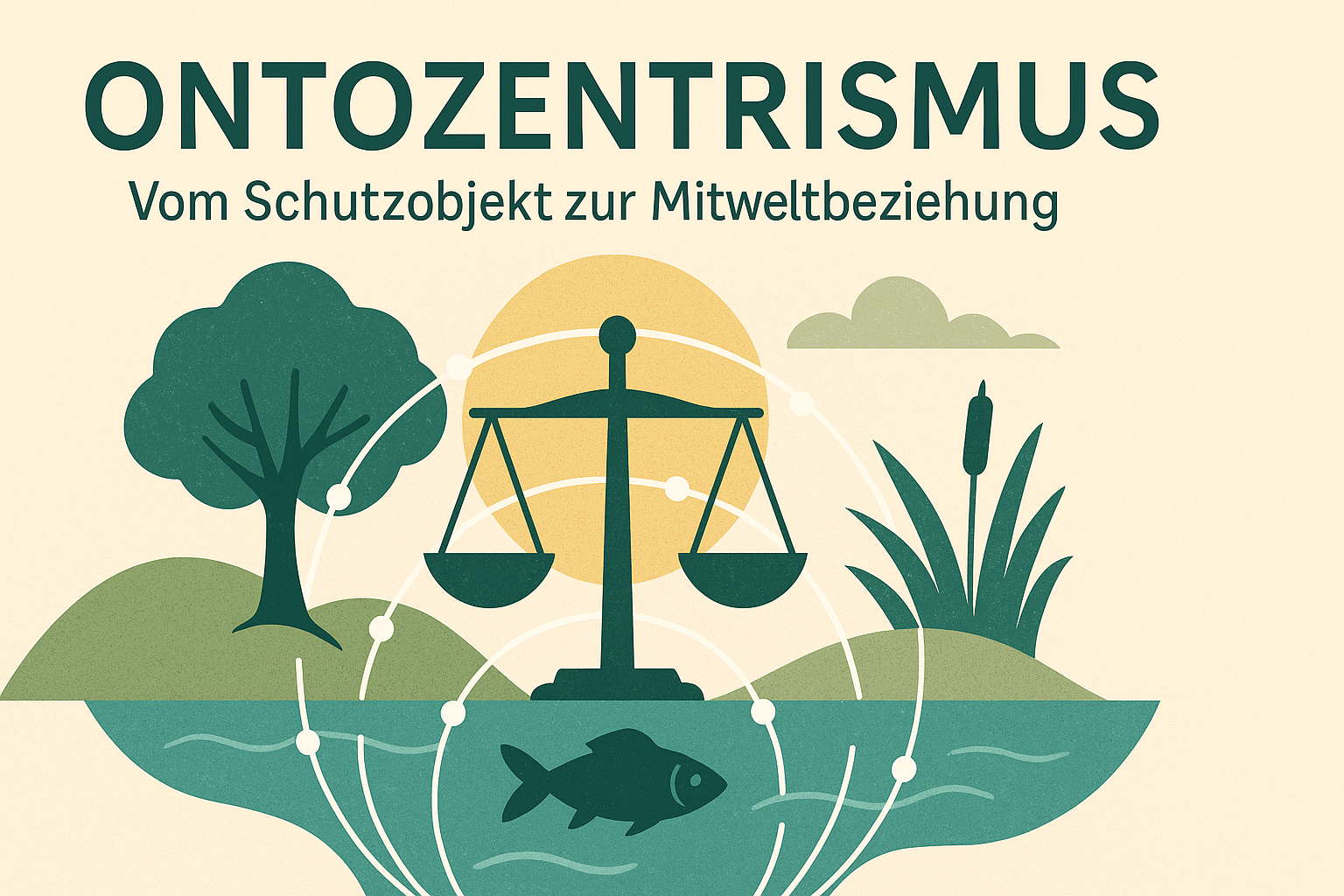
Ontocentrism describes a new understanding of law and the living world. Law is no longer understood as an external power over “nature”, but as a living sub-system of the living world that responds to its ecological foundation. The term was coined in 2025 by Hans Leo Bader and forms the theoretical basis for an ecological legal order – and for Systemic Legal Development.
In 30 seconds:
Ontocentrism means:
The law does not forget what it lives from.
When moors are drained, rivers overheat or cities heat up,
the state loses its foundation piece by piece.
Ontocentrism says:
Protect the foundations of life first – then everything else can work.
Ontocentrism means: Law is part of the living world and protects the functional capacity of the life-support systems from which it emerges itself – not “nature” as a mere object.
Ontocentrism – a new understanding of law and the living world
Ontocentrism describes law as part of the living world – not as a power over it. The concept links philosophy, ecology and constitutional law into a new understanding of state and responsibility: Law no longer protects against nature, but with it – it safeguards the functional capacity of the life-support systems from which it emerges itself.
Ontocentrism stands for a paradigm shift: law is no longer understood as an external steering instrument, but as a living system that responds to its ecological basis. This allows for a learning legal order that is related to life itself – and not only to human interests.
Within Systemic Legal Development, ontocentrism serves as the connecting principle. The citizens’ initiative “Rechte der Natur – Bayern” (“Rights of Nature – Bavaria”) is one of its practical applications – alongside further procedures that take Art. 20a GG seriously as a functional principle of the living world.
In-depth article on Zenodo:
View DOI publication “Ontocentrism”Conceptual derivation
The term ontocentrism derives from the Greek ónton (that which is, being) and kéntron (centre). Literally, it means “orientation towards being”. In this way, ontocentrism differentiates itself from familiar positions such as anthropocentrism, biocentrism or ecocentrism:
- The human being alone is not at the centre,
- nor “life” as a purely biological category,
- nor “the ecosystem” as a mere object of protection.
At the centre is being – the shared web of relations in which all forms of life are anchored. Philosophically, ontocentrism connects to a line that runs from Aristotle via Heidegger and Hans Jonas to Bruno Latour: being is understood not as possession but as relationship. Ontocentrism translates this idea into the language of law.
Why ontocentrism? – The ecological catastrophe as a legal problem
What is today described as an ecological catastrophe is also a crisis of how we understand law. A legal system that treats the natural foundations of life only as “objects of protection” loses contact with its own conditions of existence.
Classical environmental legislation usually reacts to damage that has already occurred. It protects individual objects – areas, species, emission values – without taking into account the functional capacity of the whole. Ontocentrism begins right here:
- The living world is not an external “environment” but a precondition of the legal order itself.
- The central question is not: “What is the human being allowed to do to nature?”, but: “How must law be shaped so that the life-support systems from which it emerges remain intact?”
Ontocentrism shifts the focus: from object protection to relationship with the living world, from ex-post prohibition to anticipatory safeguarding of functions.
An example:
When a moor is drained in order to build a road, the classical question is:
“Is this legally permitted?” – in other words: Have all requirements, deadlines
and limit values been complied with?
Ontocentrism asks a different first question: Is the state thereby losing an indispensable life-support system? That is: water storage, cooling, CO₂ sink, habitat. If these functions are destroyed, not only “nature” loses something; the legal system loses its own basis of stability.
From this perspective it becomes clear: ontocentrism is not an additional layer of morality, but a functional question addressed to law: “Can a state function in the long run if it destroys the systems that carry its foundations?”
Ontocentrism and constitutional law (Art. 20a GG)
Ontocentrism in law – functional protection as a standard of review
Ontocentrism becomes concrete in legal practice when law does not only balance individual interests, but examines the functional capacity of the natural foundations of life as an independent reference point. This has practical consequences for administration, legislation and courts:
- Preventive application of Art. 20a GG: decisions should not merely manage damage, but proactively minimise risks to life-support systems.
- Functional protection instead of object protection: the focus is not the individual object of protection, but the interplay between water regime, soil, climate, species and human living spaces.
- Systemic review questions: Which functions of an area or system are indispensable? Which measures threaten these functions – including slowly and cumulatively?
- Administration as a learning system: authorities do not react only to lawsuits, but use signals and submissions as an occasion to review their actions in the light of Art. 20a GG.
In this sense, ontocentrism is not an additional paragraph, but a review standard: it reminds law that its validity is bound to the stability of the living world.
Ontocentrism – the connecting principle of Systemic Legal Development
Ontocentrism forms the theoretical foundation of Systemic Legal Development – a method by which citizens can activate Art. 20a GG preventively in administrative practice.
“Ontocentrism means: Life is not an object of law, but its origin.”
It balances a central asymmetry of modern orders: economic interpretations of the Basic Law are treated as self-evident – the ecological dimension of Art. 20a GG still has to justify itself. Ontocentrism turns this order the right way up: it recognises that the legal system and consciousness are part of the same reality, and that the state does not regulate from the outside but as part of the very system on which it depends.
In this way, law becomes capable of learning: it recognises that it does not stand above the living world, but emerges from it. Ontocentrism is thus a functional principle of ecological legal development – and the framework within which the citizens’ initiative, Systemic Legal Development and further procedures relating to Art. 20a GG belong together.
Practical applications
Ontocentrism is not an abstract theory, but the foundation of concrete procedures:
-
Civil initiative “Rechte der Natur – Bayern”
Draft popular initiatives to anchor the relationship to the living world and functional protection in the Bavarian constitution. -
Systemic submissions under § 13 VwVfG / Art. 20a GG
for example concerning open-cast mines, moor and river landscapes, and large-scale infrastructure projects. -
Legal policy statements
for instance on the reform of environmental criminal law – integrating functional protection and ecological integrity into protected legal interests under criminal law.
In all these cases, ontocentrism serves as a quiet benchmark: law is measured against whether it protects the life-support systems from which it emerges.
Who is ontocentrism for?
Ontocentrism is aimed at people and institutions who are asking how law can be further developed in times of ecological catastrophe:
- Lawyers and public administration who want to go beyond simply citing Art. 20a GG and actually translate it into decisions.
- Science and civil society who are searching for a language in which the living world, state and law can be thought together.
- Initiatives and municipalities that need practical ways to safeguard life-support systems on the ground in a preventive way.
Anyone who primarily wants to know what can concretely be done will find practical cases on the page on Systemic Legal Development – there, ontocentrism is translated into administrative practice.
Short definition of ontocentrism
Ontocentrism is a term of ecological legal philosophy coined by Hans Leo Bader in 2025. It describes an understanding of law in which law is seen as part of the living world and protects its own ecological foundations. Instead of regulating “nature” as an object, an ontocentric legal system safeguards the functional capacity of life-support systems – and thus its own future viability.