

NRW: Citizens‘ submission on Article 20a of the German Constitution – Hambach (Manheim’s forest of sins)
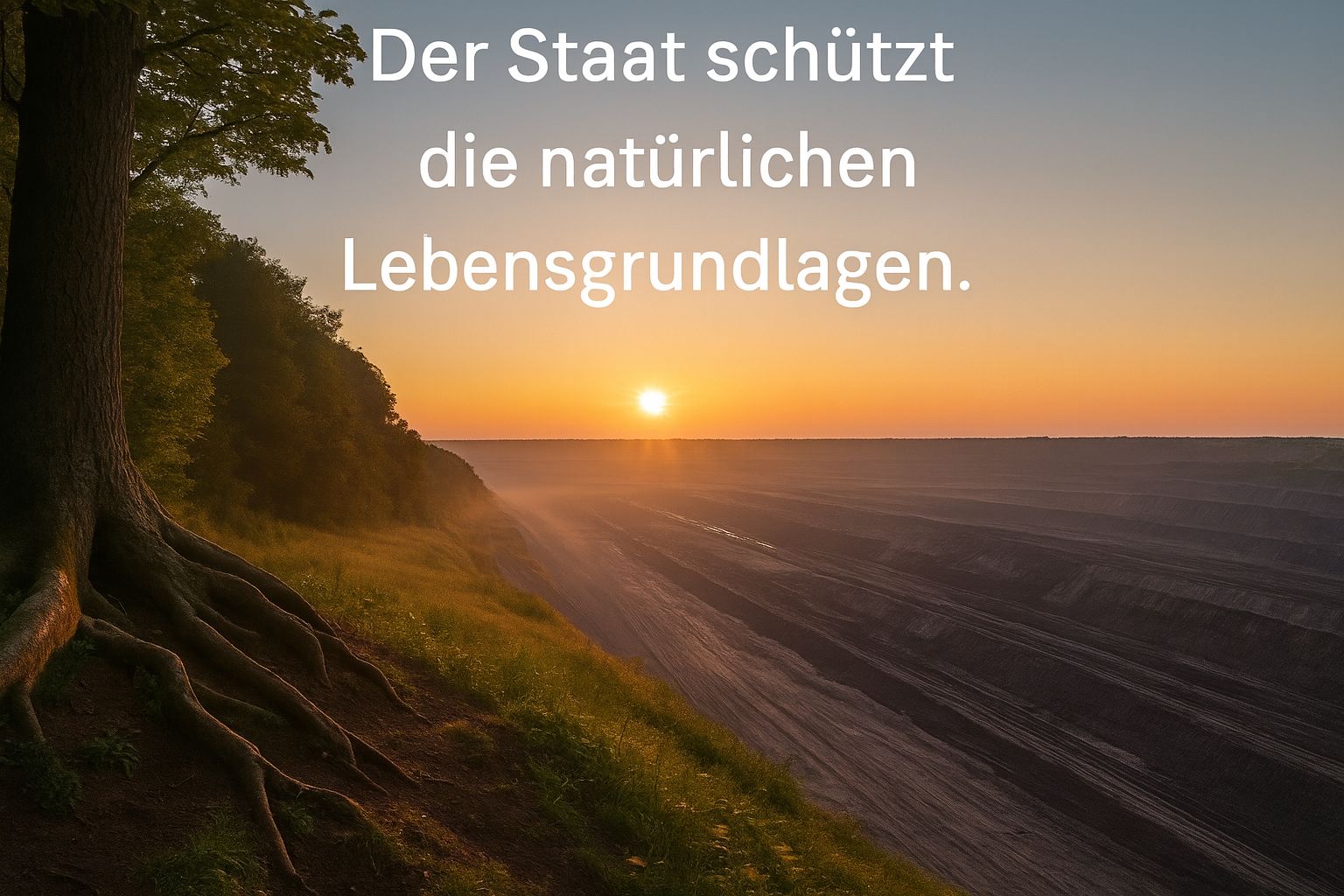
NRW: Systemic submission activates Art. 20a GG in the Hambach case
On 17 October 2025, a submission pursuant to § 13 VwVfG NRW was filed with the NRW Ministry of the Environment and the Arnsberg District Government. It calls for a constitution-guided review of ongoing earth movements and interventions at the Hambach opencast mine – in particular in the area of the Manheim Bay / “Sündenwäldchen” – for compatibility with the state duty of protection under Art. 20a GG.
From protecting nature to constitutionally bound precaution – preventive, not only after the damage has occurred.
What is new here
The submission does not claim a subjective right of action but activates an objective state duty: Art. 20a GG as a review mandate for the administration. § 13 VwVfG NRW opens the participation window so that ecological integrity is mirrored preventively in administrative practice.
Legal framework
- Location / topic: Hambach opencast mine – southern area “Manheim Bay” / “Sündenwäldchen”
- Legal basis: § 13 VwVfG NRW · Art. 20a GG · Precautionary principle Art. 191(2) TFEU · § 2(2) BNatSchG
- Objective: Constitution-guided self-review and restraint in irreversible interventions – functional protection instead of mere recultivation.
Extensions of the submission
- 30 October 2025 – First extension (Garzweiler / toxic waste): Applies the EU precautionary principle (Art. 191(2) TFEU) to the case and makes visible the protection gap between investigative confidentiality and preventive hazard control. → DOI 10.5281/zenodo.17569246
- 1 November 2025 – Second extension (holiday works “Sündenwäldchen”): Documents earthworks on a public holiday and inquires into the legal basis, competence and documentation of supervisory authorities. → DOI 10.5281/zenodo.17569788
Current status – formal resonance
By letter of 24 October 2025, the Arnsberg District Government responded to the submission. It emphasises the importance of protecting the natural foundations of life and points out that the approval of the main operating plan for Hambach (20 December 2024) repeatedly refers to Art. 20a GG and the climate-protection jurisprudence of the Federal Constitutional Court.
At the same time, the authority states that on this basis it sees no legal possibility to suspend the works and that RWE Power AG may rely on the finality of the permit.
On 10 November 2025, the NRW Ministry of the Environment forwarded the second extension, for reasons of competence, to the City of Kerpen (CC: Sabina Rothe, Helmut Scheel). This is the first visible transfer of the review impulse into the municipal level of implementation.
Hambach as a teaching case: climate litigation and Systemic Legal Development
The remnant forest at the Hambach opencast mine illustrates how differently strategic climate litigation and Systemic Legal Development operate within the same conflict – and how they can complement each other.
On the one hand, there is the environmental association’s lawsuit (BUND) against the main operating plan of RWE. Using classical tools of environmental association litigation, it seeks to stop further clearing and to establish judicial limits for the company and the State of North Rhine-Westphalia. The Higher Administrative Court Münster rejects the request for interim relief, and the clearing begins a few days later. Juridically important, politically visible – but for the forest, the signal comes too late.
In parallel, Systemic Legal Development takes a different approach at the same site: via submissions under § 13 VwVfG NRW in conjunction with Art. 20a GG to the Arnsberg District Government. These submissions force the authority to address the CO2-sink function, the functional protection of soil and ecological connectivity, and the proportionality of the planned earth movements. They generate an administrative record, a duty to justify, and a documented learning trace for future decisions.
In short:
- The Hambach climate lawsuit aims for a judicial stop signal, creates public attention and fundamental clarification, but proceeds slowly and ends in a binary outcome: won or lost.
- Systemic Legal Development activates Art. 20a GG already within ongoing administrative practice, works with resonance cycles (submission, response, extensions) and builds a reference for how functional protection of the living world must be examined in comparable procedures.
The case illustrates what is meant by the implementation gap, i.e. the gap between what constitutional law and court decisions require and what is actually examined and justified in everyday administrative practice. Systemic Legal Development addresses exactly this point. It does not replace climate litigation; instead, in the Hambach case it concretely closes this implementation gap between landmark rulings and day-to-day administration. Climate lawsuits establish legal principles; Systemic Legal Development brings them into the daily work of the administration.